



Weldy WGW 300 Hot Wedge Welding Machine | Heavy-Duty HDPE Geomembrane Welder | Dubai UAE
The Production Machine for Landfills, Mines, Reservoirs and Large Ponds
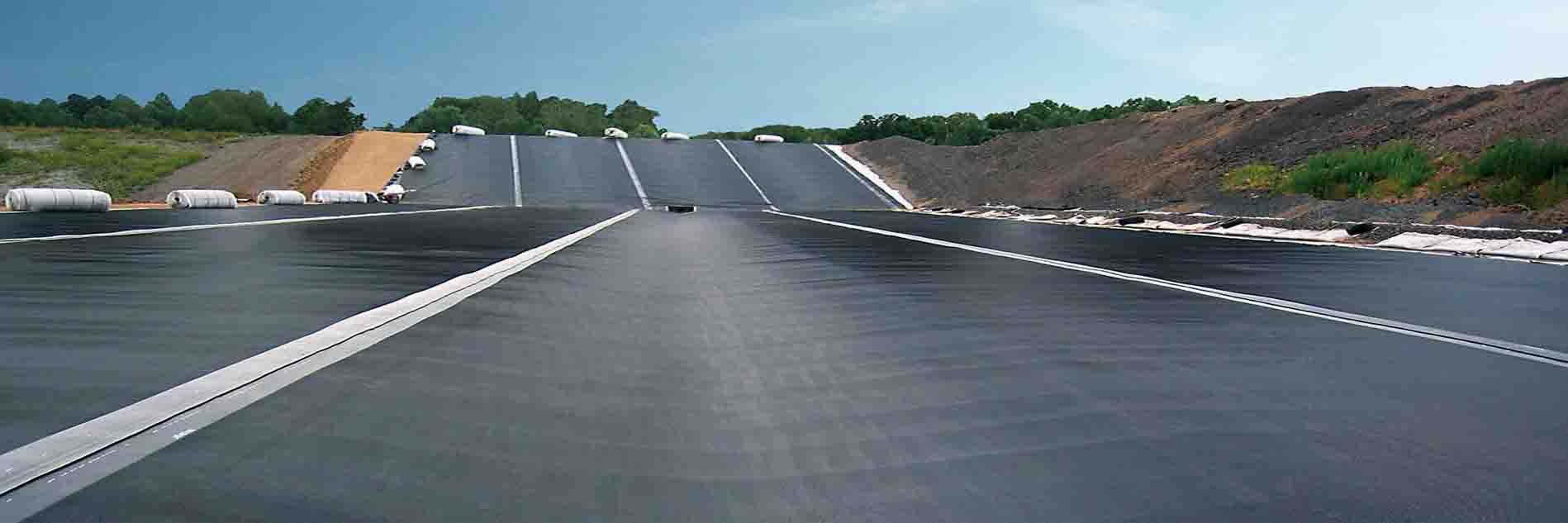
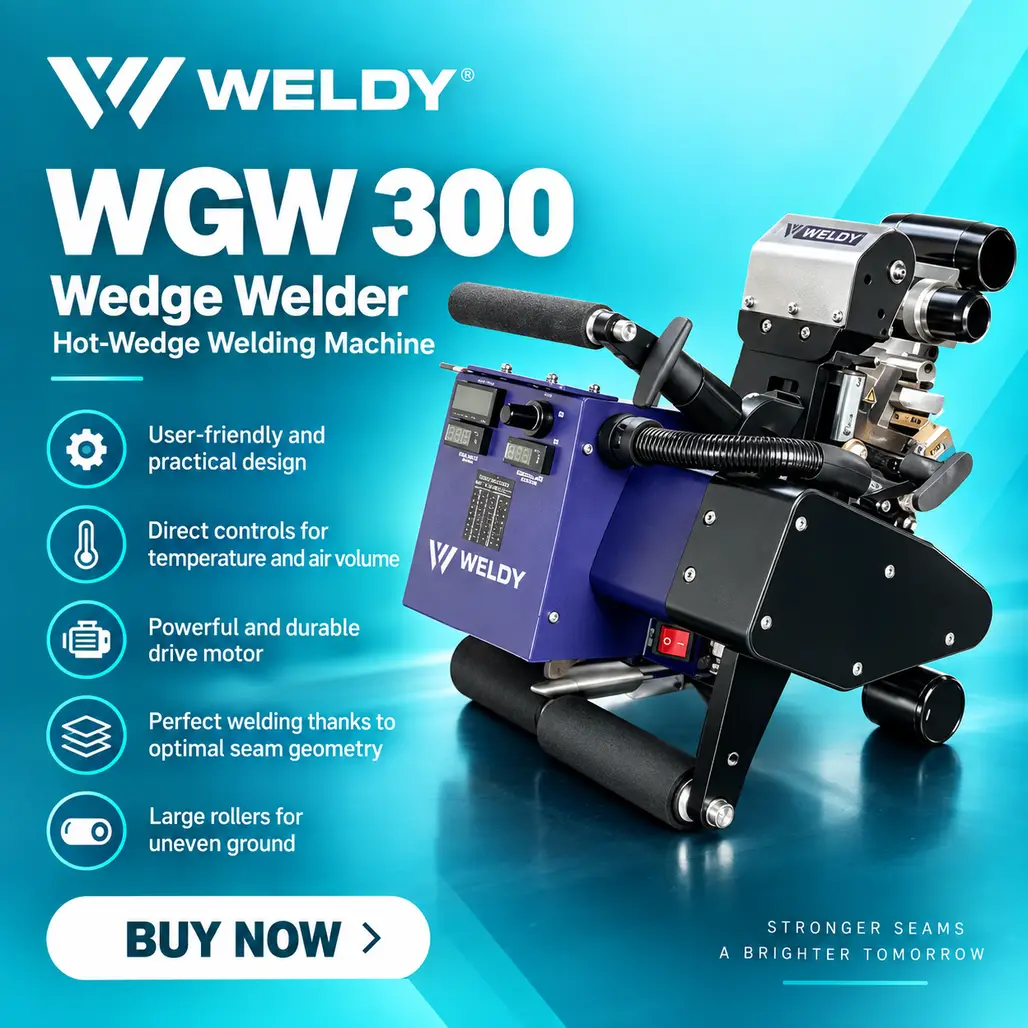
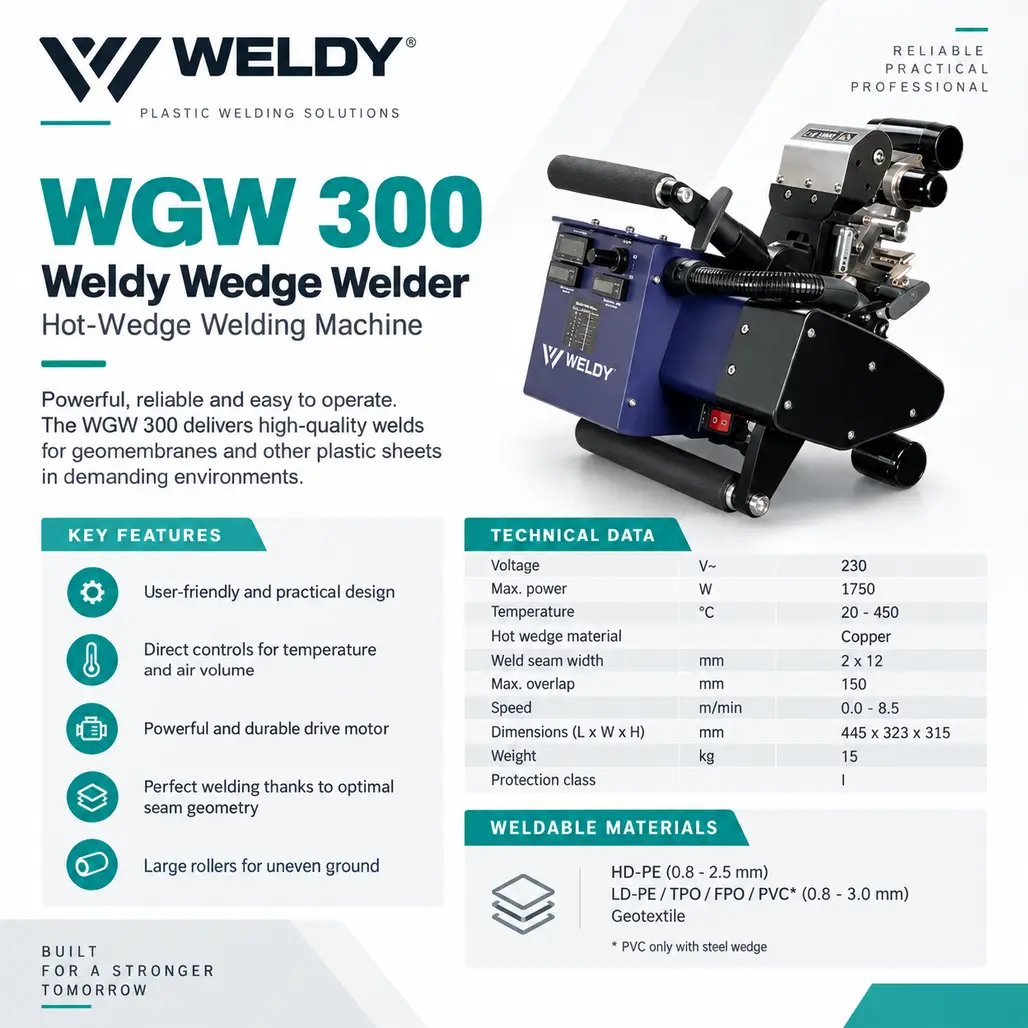
When a project bill of quantities reads in hectares rather than metres — a landfill cell in the Northern Emirates, a mining containment pond, a reservoir liner in Al Ain, a fish breeding basin complex on the coast — the welding machine becomes the critical path of the whole installation. The Weldy WGW 300 is built for exactly this scale: a robust, self-propelled hot wedge welding machine that seams heavy HDPE geomembranes from 0.8 to 2.5 mm (and LD-PE, TPO, FPO and PVC from 0.8 to 3.0 mm) at speeds up to 8.5 m/min — the fastest and heaviest-duty seamer in our Weldy range.
Its 1750W system drives a copper hot wedge through a generous 150 mm overlap capacity, producing the industry-standard 2 × 12 mm double seam with test channel that consultants pressure-test and sign off on containment works worldwide. And because real liner sites are never billiard tables, the WGW 300 rides on large rollers designed for uneven ground, holding seam alignment over subgrade imperfections that would derail lighter machines.
Key Features of the Weldy WGW 300
Welds Heavy HDPE up to 2.5 mm
This is the WGW 300’s defining capability. The 1.5 mm and 2.0 mm HDPE liners specified on UAE landfills, leachate ponds and industrial containment are beyond every Miniwelder — the Geo2 tops out at 1.0 mm HDPE — and squarely inside the WGW 300’s range. It also handles geotextiles, and PVC with the steel wedge option.
Powerful, Durable Drive Motor — Up to 8.5 m/min
Thick liners resist feeding; the WGW 300’s drive motor doesn’t care. Speed adjusts steplessly from crawl to 8.5 m/min, and the machine holds its set speed under the full drag of 2.5 mm HDPE — which is precisely what keeps heat input, and therefore seam strength, uniform across a 100-metre run.
Optimal Seam Geometry with Test Channel
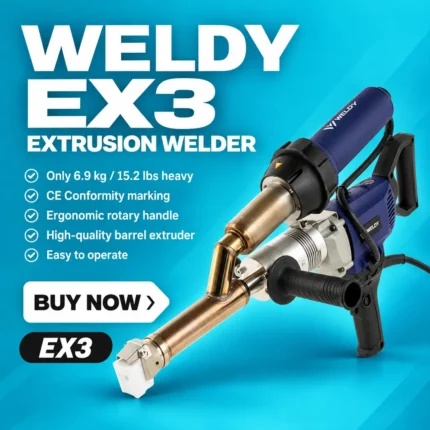
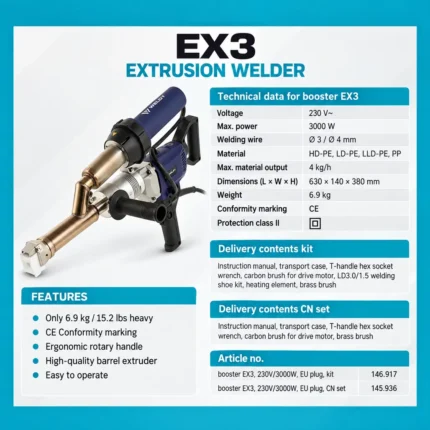
Weldy engineered the wedge, pressure rollers and material path so both weld tracks fuse evenly across their full 12 mm width. The result is a double seam that passes air-pressure testing consistently — fewer failed tests means fewer cut-outs, extrusion repairs and delays. (For those repairs and details, crews run the Booster EX2 or Booster EX3 extrusion welder alongside.)
Direct Controls for Temperature and Welding Parameters
No menus, no laptops: temperature (up to 450°C) and machine parameters adjust via direct controls the operator reads at a glance under full sun — a practical, user-friendly design philosophy that suits multilingual site crews across the Emirates.
Large Rollers for Uneven Ground
Compacted subgrade always has undulations, anchor trench transitions and wrinkle zones. The WGW 300’s oversized rollers bridge these, keeping wedge contact and nip pressure constant — one of the main reasons it produces uniform seams in field conditions, not just on flat workshop floors.
Site-Ready Delivery
Supplied with transport box, three Allen keys, spare fuses and cleaning brush. At 15 kg and 445 × 323 × 315 mm, it travels between cells and sites in any pickup, with an industrial plug for 230V site power.
WGW 300 vs Miniwelder Geo2 — Which Geomembrane Welder Do You Need?
- WGW 300 (this page): HDPE 0.8 – 2.5 mm, LD-PE/TPO/FPO/PVC 0.8 – 3.0 mm, 150 mm overlap, up to 8.5 m/min, 15 kg — landfills, mines, large reservoirs, major pond works.
- Miniwelder Geo2: HDPE 0.4 – 1.0 mm and liners to 1.5 mm, 100 mm overlap, 3.9 kg — fish farms, water tanks, foundation sealing and light-to-medium liners; see the lightweight Miniwelder Geo2.
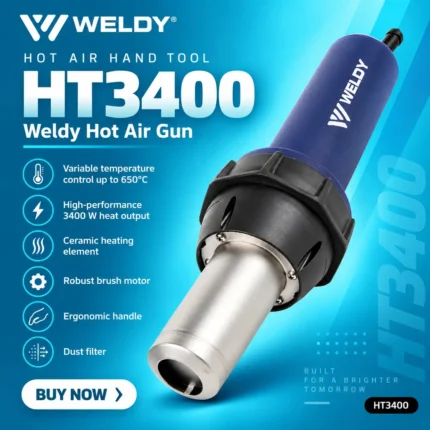
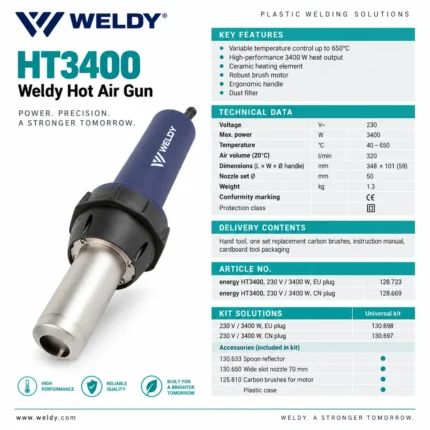
Simple rule: liner 1.5 mm HDPE or thicker → WGW 300; liner 1.0 mm or thinner and portability matters → Geo2. For thin membranes and films below the geomembrane class, the Miniwelder Tex2 (0.1–1.0 mm) and Miniwelder Tex1 (from 0.05 mm) complete the wedge family, and hot-air tools like the Weldy HT1600 and digital HT1600 D handle tacking, patches and detail work on every liner project.
Applications Across Dubai, Sharjah, Abu Dhabi and the UAE
- Landfills – base and capping liners, leachate ponds, cell expansions
- Mining and industrial containment – process ponds, secondary containment bunds
- Reservoirs and irrigation lagoons – agricultural and municipal water storage
- Fish breeding basins and aquaculture – large-format pond complexes
- Artificial lakes and leisure water bodies – parks, golf courses and developments
- Geotextile seaming – protection and separation layers laid with the liner
Weldy WGW 300 Technical Specifications
| Specification | Value |
|---|---|
| Voltage | 230 V~ |
| Maximum power | 1750 W |
| Temperature | up to 450 °C |
| Hot wedge material | Copper (steel wedge for PVC) |
| Weld seam width | 2 × 12 mm (with test channel) |
| Max. overlap | 150 mm |
| Welding speed | 0.0 – 8.5 m/min |
| Dimensions (L × W × H) | 445 × 323 × 315 mm |
| Weight | 15 kg |
| Weldable materials | HD-PE (0.8 – 2.5 mm); LD-PE / TPO / FPO / PVC (0.8 – 3.0 mm); Geotextile — PVC only with steel wedge |
| Protection class | I |
| Plug | 230V industrial plug |
Delivery contents: Instruction manual, transport box, 3 Allen keys, spare fuses, cleaning brush.
Buy the Weldy WGW 300 in Dubai, Sharjah, Abu Dhabi & Across the UAE
We supply the genuine WGW 300 from our Deira, Dubai stock with delivery across Dubai, Sharjah, Abu Dhabi, Ajman, Ras Al Khaimah, Fujairah, Umm Al Quwain and Al Ain. Geosynthetics installers on landfill and infrastructure contracts, aquaculture developers, and earthworks contractors lining reservoirs choose the WGW 300 where liner thickness and daily metreage rule out lighter machines — with wedges, rollers and spares supported locally.
📞 Call now: +971 50 178 9490
Frequently Asked Questions – Weldy WGW 300
What liner thickness can the WGW 300 weld?
HD-PE from 0.8 to 2.5 mm, and LD-PE, TPO, FPO and PVC from 0.8 to 3.0 mm (PVC with the steel wedge), plus geotextiles — the heavy-liner range specified on landfills, mines and major ponds.
Does the WGW 300 produce a testable seam?
Yes — a 2 × 12 mm double weld with a central air-test channel, the standard for non-destructive QC testing and consultant sign-off on containment projects.
How fast is the WGW 300?
Steplessly adjustable from 0 to 8.5 m/min. On 1.5 mm HDPE in good conditions, one machine routinely delivers several hundred metres of tested seam per shift.
WGW 300 or Miniwelder Geo2 — which should I buy?
Buy the WGW 300 for liners of 1.5 mm HDPE and above and large-format sites; buy the Geo2 for liners up to 1.0–1.5 mm where its 3.9 kg portability wins. Many geosynthetics contractors run both.
Can it work on rough, uneven subgrade?
Yes — large rollers are a core design feature, maintaining seam alignment and nip pressure over the undulating compacted ground typical of UAE earthworks.
What power supply does it need on site?
230V with an industrial plug — standard UAE site distribution or an appropriately sized generator.
Do you deliver the WGW 300 to landfill and remote sites across the UAE?
Yes — UAE-wide from Dubai stock, typically 1–2 working days, including remote project locations. Call +971 50 178 9490 to discuss wedge options, spares and commissioning support.
















 Pool Tiles


