


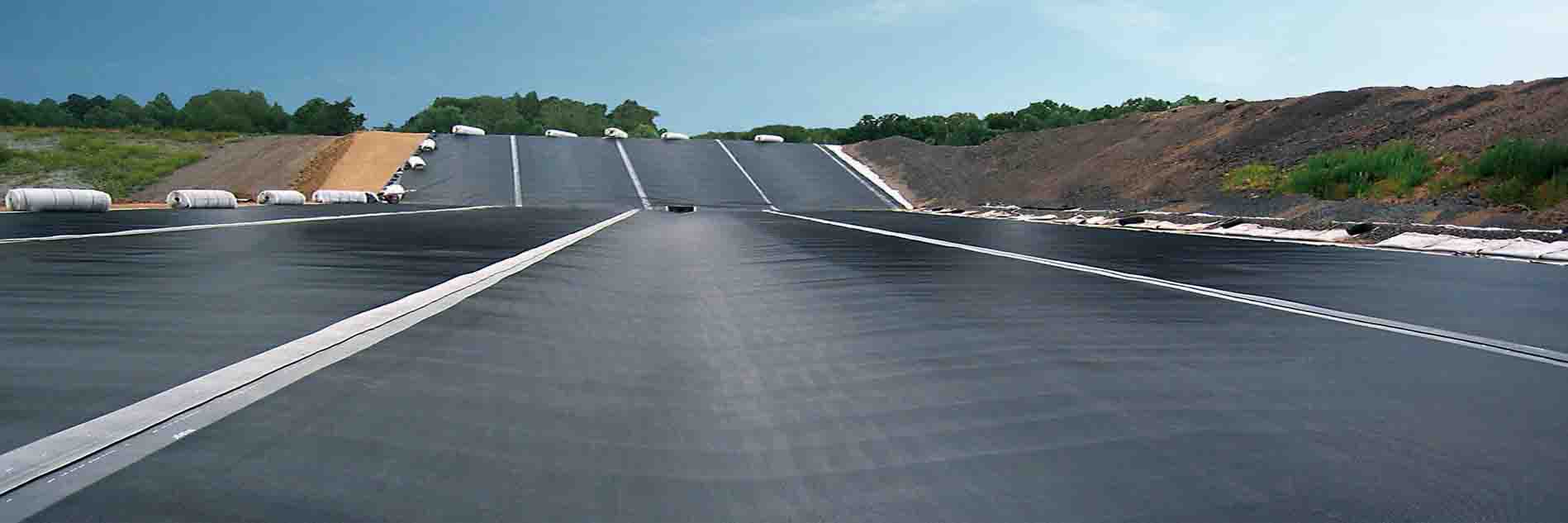


A geomembrane liner is only as good as its seams. The sheet itself arrives from the factory with certified properties — but every metre of weld is created on site, in heat, wind and dust, by a machine and an operator. On a lined pond, landfill cell or reservoir, the seams are where containment succeeds or fails, which is why geomembrane welding is treated as a controlled, tested process rather than simple joining.
This guide covers the full picture: the materials, the two welding methods and where each is used, the site process step by step, and the seam tests that prove the work — as practised on containment projects across the UAE.
Table of Contents
ToggleWhat Is Geomembrane Welding?
Geomembrane welding is the thermal fusion of overlapping liner sheets — HDPE, LDPE, PVC or TPO/FPO, typically 0.5–2.5mm thick — into a continuous, leak-proof barrier. No adhesives, no tapes: heat and pressure fuse the polymer itself, so a correct seam is chemically one piece with the sheets it joins. Two methods do essentially all the work on modern sites: hot wedge welding for the long seams, and extrusion welding for the details.
Method 1: Hot Wedge Welding — The Long Seams
A self-propelled wedge welder drives along the panel overlap, melting both contact surfaces over a heated metal wedge and fusing them under roller pressure. Geomembrane-class machines weld a double seam (typically 2 × 12mm) with an air-testable channel between the tracks — the feature that makes non-destructive QC possible. (Full machine anatomy in our wedge welder guide.)
Machine choice follows liner thickness: the Weldy Miniwelder Geo2 covers liners to 1.5mm at under 4kg, the IZ-900 hot wedge machine handles HDPE, LDPE, PVC and EVA installation work, and heavy cells run the Weldy WGW 300 — HDPE to 2.5mm at up to 8.5 m/min on large rollers built for real subgrade.
Method 2: Extrusion Welding — The Details
Wherever a rolling machine can't go — pipe penetrations, sump corners, anchor trench transitions, patches and repairs — a hand extruder lays a structural bead of molten filler wire over the prepared joint. The Booster EX2 is the standard detail machine, with the higher-output Booster EX3 on projects heavy with penetrations. (Process fundamentals in our extrusion welding guide.) A hot air gun such as the Weldy HT1600 completes the kit for tack welds and pre-heating.
The Site Process, Step by Step
- Subgrade and panel layout. Panels are deployed to the approved layout with correct overlap (commonly ~100mm for wedge seams), oriented to minimise seams across slopes.
- Trial welds. Before production each shift — and after significant weather change — the crew welds test strips at the day's settings and peel/shear-tests them. Only passing settings go to production; this single habit prevents most seam failures.
- Seam preparation. Overlaps are cleaned and dried; dust and moisture are the primary enemies of fusion, which makes this step relentless on UAE sites.
- Production welding. The wedge machine runs the long seams at set temperature and speed; extrusion crews follow on details, scraping the oxidised surface layer immediately before each weld.
- Testing and documentation. Every seam is tested (below), logged with machine settings, operator and location — the record consultants sign off against.
Seam Testing: How Welds Are Proven
- Air pressure testing (non-destructive). The channel between the double wedge-weld tracks is sealed at both ends and pressurised; holding pressure over the test period proves both tracks continuous. The standard test for wedge seams.
- Vacuum box testing (non-destructive). A soaped seam section under a transparent vacuum box reveals leaks as bubbles — used on extrusion welds and repairs where no channel exists.
- Spark testing (non-destructive). A conductive wire laid under extrusion welds allows a high-voltage probe to reveal pinholes as sparks.
- Destructive peel and shear tests. Coupons cut from trial welds (and sampled production seams) are pulled in a tensiometer; passing seams fail in the parent sheet, not the weld. The destructive proof behind the non-destructive routine.
Welding in UAE Conditions: Three Local Realities
- Heat. Sheet surface temperatures in summer shift welding parameters — trial welds per shift, shaded liner storage, and early-morning or night welding on the hottest months are standard practice.
- Sand and dust. Constant seam cleaning and machines with protected drives (chainless systems, dust-filtered motors) keep fusion surfaces and equipment alive.
- Wind. Panels are ballasted immediately; welding into wrinkles is the classic cause of failed sections, so layout discipline matters as much as machine settings.
Building or Upgrading a Geomembrane Welding Kit
A complete crew runs three machine roles — wedge welder for seams, extruder for details, hot air gun for tacks and patches — matched to your liner thickness. Machine classes and costs are broken down in our wedge welder price guide (and the rent vs buy analysis if it's your first lining contract). Everything above — machines, wedges, rollers, welding wire and shoes — ships from our Dubai stock across the UAE in 1–2 working days: browse the machines and tools range or call +971 50 178 9490 with your liner spec for a complete kit quotation.
FAQs — Geomembrane Welding
What is geomembrane welding?
The thermal fusion of overlapping liner sheets (HDPE, LDPE, PVC, TPO) into a continuous leak-proof barrier — using hot wedge machines for long seams and extrusion welders for details, with every seam tested and documented.
Which machine is used for geomembrane welding?
Self-propelled hot wedge welders run the long seams (Miniwelder Geo2 class for liners to 1.5mm, WGW 300 class for HDPE to 2.5mm), while hand extruders like the Booster EX2/EX3 weld penetrations, corners and repairs.
How are geomembrane seams tested?
Air pressure testing of the double-seam channel for wedge welds, vacuum box and spark testing for extrusion welds, and destructive peel/shear tests on trial-weld coupons — a passing seam breaks in the sheet, not the weld.
What is a trial weld and why is it required?
A short test seam welded at the day's settings and destructively tested before production begins each shift. It calibrates temperature and speed to that day's material and weather — the cheapest quality control on the entire project.
Can HDPE geomembrane be welded in UAE summer heat?
Yes — with adapted practice: per-shift trial welds, parameter adjustment for hot sheet surfaces, shaded material storage and scheduling production for cooler hours on extreme days.
What thickness of geomembrane can be welded?
Common project liners run 0.5–2.5mm: machines like the Geo2 cover up to 1.5mm, and heavy-duty units like the WGW 300 weld HDPE to 2.5mm and other materials to 3.0mm.









 Pool Tiles


