


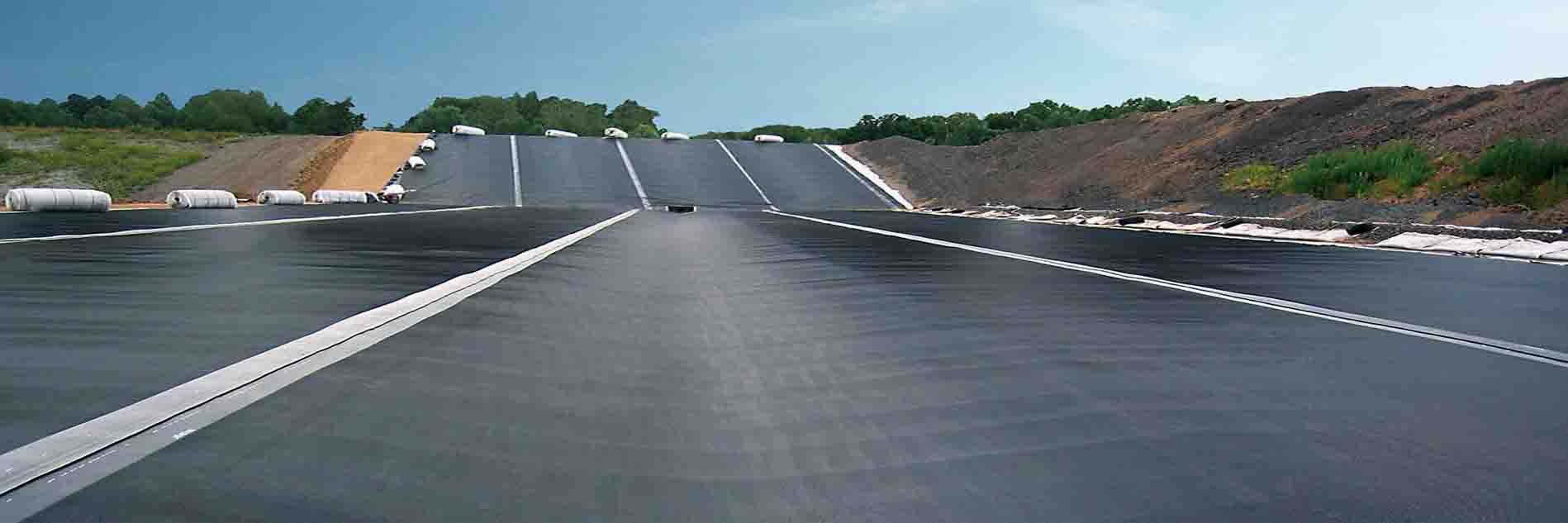


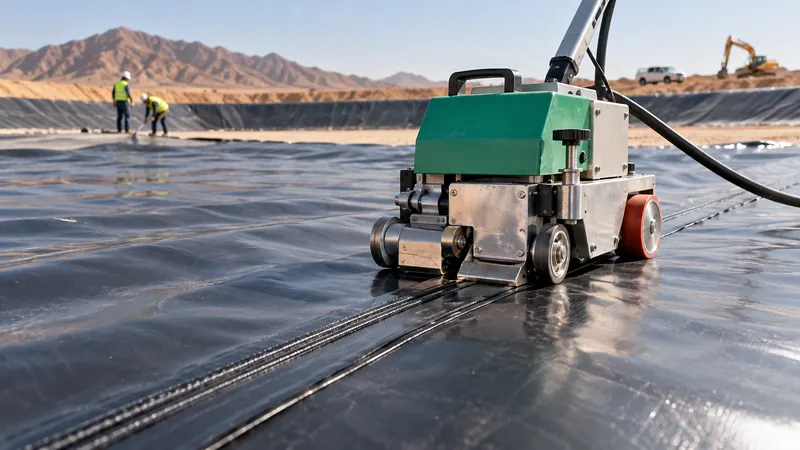
If you've ever watched a pond, landfill or reservoir being lined, you'll have seen a small machine crawling slowly along the overlap between two liner sheets, leaving behind a neat double track of weld. That machine is a wedge welder — and it's the reason modern geomembrane installations can be hundreds of metres long yet completely leak-proof.
This guide answers what a wedge welder is, how the hot wedge process actually fuses plastic, why its double seam can be pressure-tested, and how to pick the right machine class for your material.
Table of Contents
ToggleWhat Is a Wedge Welder? The Definition
A wedge welder (also called a hot wedge welding machine) is a self-propelled machine that joins two overlapping thermoplastic sheets by driving them over an electrically heated metal wedge. As the sheets pass either side of the hot wedge, their contact surfaces melt; a pair of pressure rollers immediately squeezes the molten surfaces together, and the sheets fuse into one continuous piece as they cool.
Unlike extrusion welding, no filler material is added — the sheets themselves are the weld. And unlike hand welding with a hot air gun, the machine drives itself along the seam at a constant, adjustable speed, which is what makes wedge-welded seams so uniform over long distances.
How Hot Wedge Welding Works, Step by Step
- Overlap preparation. The two sheets are overlapped (typically up to 100–150mm depending on the machine) and the seam path is cleaned — dust and moisture are the enemies of fusion.
- Machine setup. The operator sets wedge temperature and travel speed for the material and thickness; on modern machines like the Weldy Miniwelder Geo2, the wedge even positions itself automatically at the start of the seam.
- Welding. The machine clamps the overlap, feeds both sheets over the heated wedge, and the drive rollers pull it forward — at anywhere from a slow crawl to 8.5 m/min on production machines.
- Pressure and cooling. Nip rollers press the molten surfaces together directly behind the wedge; the seam cools within seconds under the machine's own trailing pressure.
Because temperature, speed and pressure are machine-controlled rather than hand-controlled, metre 300 of the seam is identical to metre 1 — the core advantage over any manual method.
The Double Seam and Test Channel: Why Consultants Specify Wedge Welding
Geomembrane-class wedge welders use a split wedge that creates two parallel weld tracks (typically 2 × 12mm) with an unwelded channel between them. That channel is the quality-control feature that sets wedge welding apart: after welding, the crew seals both ends of a seam section, pumps air into the channel, and watches the pressure gauge. If pressure holds, both welds are continuous and tight — proven without cutting or damaging the liner.
This non-destructive air pressure test is why project consultants across the UAE specify wedge welding for the long seams on landfills, ponds and tank linings, reserving extrusion welding for the corners, penetrations and details a rolling machine can't reach.
Wedge Welder Types by Material Thickness
"Wedge welder" covers machines from 3.5kg film seamers to 15kg landfill units. The right class depends almost entirely on your material thickness:
| Material thickness | Machine class | Typical work |
|---|---|---|
| 0.05 – 1.0mm foils | Miniwelder Tex1 (ball wedge) | Greenhouse films, agricultural covers |
| 0.1 – 1.0mm membranes | Miniwelder Tex2 (20mm seam) | Roofing, waterproofing, fabrics |
| 0.2 – 1.5mm geomembranes | 800W thin geomembrane welder | Thin liners, decorative ponds |
| 0.4 – 1.5mm liners | Miniwelder Geo2 (double seam) | Fish farms, tanks, foundation sealing |
| HDPE, LDPE, PVC, EVA liners | IZ-900 hot wedge machine | General geomembrane installation |
| 0.8 – 2.5mm HDPE | Weldy WGW 300 / heavy duty wedge welder | Landfills, mines, large reservoirs |
What Materials Can a Wedge Welder Join?
The common thermoplastic sheet families: HDPE, LDPE and LLDPE (the geomembrane standards), PVC (usually requiring a steel wedge instead of copper), TPO/FPO roofing membranes, PP, and on heavy machines even geotextiles. As with all fusion welding, both sheets must be the same material family — a wedge welder cannot join PVC to HDPE.
Where Wedge Welders Work Across the UAE
- Landfill cells and capping — the classic heavy-duty application
- Irrigation reservoirs and farm ponds — Al Ain, Al Dhaid and the Western Region
- Fish farms and aquaculture basins — coastal projects in RAK, Fujairah and Abu Dhabi
- Water tanks and foundation sealing — basement tanking on Dubai and Sharjah builds
- Artificial lakes and leisure water bodies — hotels, parks and golf courses
- Roofing and cover fabrication — with the thin-membrane machine classes
Choosing and Buying a Wedge Welder in the UAE
Start with your material and thickness, then the seam type your project specification demands (single wide seam vs testable double seam), and only then compare prices — wedge welders in the UAE run from roughly AED 6,500 for thin-film machines to AED 23,500 for heavy geomembrane units, covered in detail in our UAE welding machine price guide. Browse every class in our machines and tools range, or call +971 50 178 9490 with your liner spec and we'll match the machine, wedge type and rollers for your project — delivered anywhere in Dubai, Sharjah, Abu Dhabi and across the UAE.
FAQs — Wedge Welders
What is a wedge welder used for?
Joining long overlapping seams on thermoplastic sheets — geomembrane liners for ponds, landfills and tanks, plus films, roofing membranes and industrial fabrics — quickly and with machine-consistent quality.
How is wedge welding different from hot air welding?
A wedge welder melts the sheets by direct contact with a heated metal wedge and drives itself along the seam automatically; hot air welding is a manual, hand-guided process using heated air. Wedge welding wins on long seams; hot air wins on details, corners and repairs.
What is the test channel in a wedge weld?
The unwelded gap between the two parallel weld tracks of a double seam. Sealing the ends and pressurising this channel with air proves both welds are continuous — the standard non-destructive QC test on lined containment projects.
Can a wedge welder weld PVC?
Yes, but most machines need a steel wedge for PVC instead of the copper wedge used for PE materials — confirm the wedge variant when ordering.
What thickness can wedge welding machines handle?
As a family, from 0.05mm foils (ball-wedge machines) up to 2.5mm HDPE and 3.0mm PVC/TPO on heavy-duty units — but each machine covers only its own band, which is why matching machine class to liner thickness is the key buying decision.
How fast does a wedge welder work?
Typically 0.4–7.5 m/min on compact machines and up to 8.5 m/min on production units — several hundred metres of finished, testable seam per operator per day in good conditions.









 Pool Tiles


