




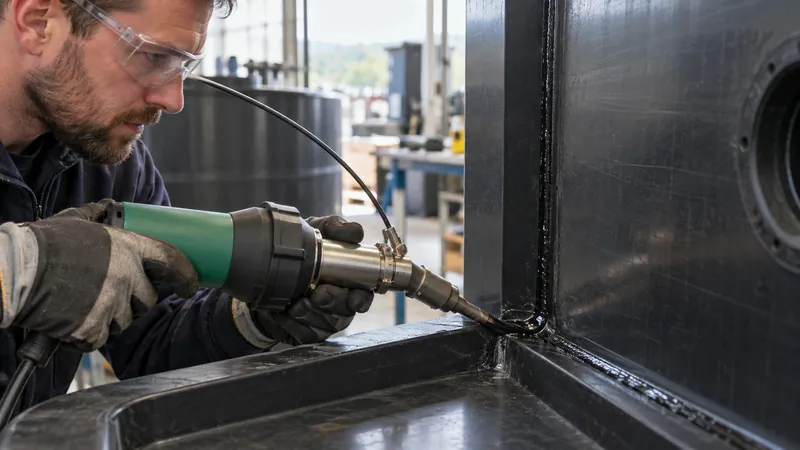
Walk past any HDPE tank being fabricated in a Sharjah workshop or a landfill liner being detailed in the desert, and you'll see the same tool in action: a hand-held machine feeding plastic wire into itself and laying down a thick, glossy bead along the joint. That process is extrusion welding — and if you work with thermoplastics in any structural capacity, it's the technique that makes load-bearing plastic construction possible.
This guide explains what extrusion welding is, how the process actually works step by step, which materials it joins, and when to choose it over other plastic welding methods.
Table of Contents
ToggleExtrusion Welding: The Simple Definition
Extrusion welding is a plastic joining process in which a filler material — thermoplastic welding wire, usually 3mm or 4mm in diameter — is melted inside a hand-held extruder and pushed out as a continuous molten bead into a prepared joint between two plastic parts. At the same time, a stream of hot air (or gas) preheats the surfaces of the parent material, so the molten bead and the softened surfaces fuse together into one homogeneous mass.
The result is fundamentally different from a glued or mechanically fastened joint: after cooling, the weld and the parent material are chemically one piece of plastic. Done correctly, the joint is as strong as — sometimes stronger than — the sheet it connects.
One clarification, because search results often mix the two: extrusion welding joins plastics. "Metal extrusion" is an unrelated manufacturing process where metal is forced through a die to create profiles — it has nothing to do with welding.
How Does Extrusion Welding Work? The Process Step by Step
- Joint preparation. Surfaces are scraped clean with a scraper set to remove the oxidised layer — the single most skipped step and the most common cause of weak welds. Thicker sections are bevelled into a V-groove.
- Tack welding. The parts are positioned and tacked in place, typically with a hot air tool such as the Weldy HT1600, so nothing moves during the main weld.
- Preheating. The extruder's integrated hot air stream heats the joint surfaces just ahead of the bead, bringing them to fusion temperature.
- Extrusion. Welding wire feeds into the machine, where a rotating screw inside a heated barrel plasticises it into a uniform melt and forces it out through a PTFE welding shoe shaped for the joint — V-weld, fillet, overlap or corner.
- Shaping and cooling. The shoe presses and shapes the molten bead into the groove as the operator moves along the seam. The weld cools naturally; no clamping is needed.
Machine settings — melt temperature, air preheat temperature and travel speed — depend on the material. PP, for example, welds at different parameters than HDPE, which is why professional extruders offer independent control of both temperatures.
What Materials Can Be Extrusion Welded?
Extrusion welding works on thermoplastics — plastics that soften when heated and harden again when cooled, repeatedly. In practice, the workhorses are the polyolefin family:
- HDPE (high-density polyethylene) — tanks, geomembrane liners, pipes, chemical containers
- LDPE and LLDPE — flexible liners and lighter fabrications
- PP (polypropylene) — ventilation ducting, electroplating baths, lab furniture, aggressive-chemical tanks
The golden rule: filler wire must match the parent material. HDPE wire welds HDPE; PP wire welds PP. Mixing them produces a bead that looks fine and fails under load. Thermoset plastics (which char rather than melt) cannot be extrusion welded at all.
What Equipment Do You Need?
- A hand extruder — the core machine. In the UAE the two standard professional options are the Weldy Booster EX2 (3000W, up to 2.5 kg/h of weld output, with 360° rotating welding shoes) for fabrication and repair work, and the Weldy Booster EX3 (3.4 kg/h barrel extruder) for production-volume welding on large tanks and lining contracts.
- Welding wire — 5 kg spools of HDPE or PP in Ø3/Ø4mm.
- Welding shoes — PTFE shoes matched to the joint geometry: V-weld, fillet, overlap and corner profiles.
- Preparation tools — scraper set, bevelling tools, and a hot air gun for tacking and detail work.
Where Extrusion Welding Is Used in the UAE
- Tank and container construction — chemical storage, water tanks and electroplating baths built in fabrication shops across Sharjah and Mussafah
- Pipe construction — large-diameter HDPE pipe joints, custom fittings and manifolds
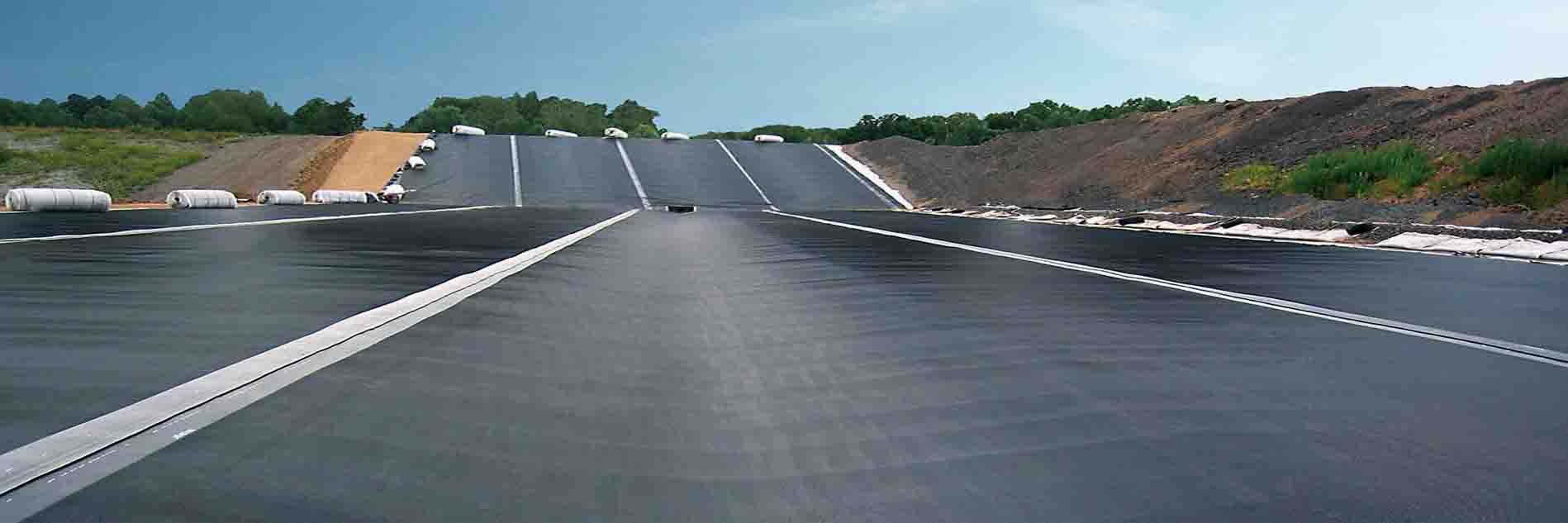
- Landfill and containment lining — pipe penetrations, anchor details, patches and repairs on geomembranes whose long seams are welded by machines like the Weldy WGW 300 hot wedge welder
- Water and sewage infrastructure — treatment plant internals, sumps and manholes
- Aquaculture and leisure — fish farm tanks, pools and water features
- Structural repairs — cracked PE/PP components in industry, marine and transport
Extrusion Welding vs Hot Air Welding vs Wedge Welding
| Method | Uses filler? | Best for |
|---|---|---|
| Extrusion welding | Yes — molten bead | Thick-wall structural joints: tanks, pipes, liner details |
| Hot air welding | Optional — thin rod or none | Membranes, sheets, repairs, detail and tack work |
| Hot wedge welding | No — sheets fused directly | Long automatic seams on films, membranes and geomembranes |
On real projects the three work together: a wedge machine such as the Miniwelder Geo2 runs the long liner seams, the extruder handles corners, penetrations and structural details, and the hot air gun tacks and patches. You can compare all three technologies side by side in our plastic welding machines range.
5 Tips for Strong Extrusion Welds
- Always scrape first. The oxidised surface layer prevents fusion — remove it minutes before welding, not the day before.
- Match wire to material — and store wire clean and dry; contaminated wire means voids in the bead.
- Respect the preheat. A cold parent surface under a hot bead produces a "cold weld" that peels under stress.
- Keep travel speed steady. Speeding up starves the joint of material; slowing down overheats and degrades it.
- Test your work. On critical seams, run spark testing or destructive peel tests on trial coupons before production welding.
FAQs — Extrusion Welding
What is extrusion welding in simple terms?
It's joining two plastic parts by melting matching plastic wire inside a hand-held machine and laying the molten material into the joint, where it fuses with the preheated surfaces and cools into one solid piece.
What is an extrusion welding machine?
A hand-held unit combining a wire feed, a motor-driven screw inside a heated barrel that melts the wire, a hot air preheater for the joint surfaces, and a shaped welding shoe that forms the bead. Professional examples include the Weldy Booster EX2 and EX3.
How strong is an extrusion weld?
A correctly executed extrusion weld achieves strength comparable to the parent material — which is why it's specified for load-bearing tanks, pressure-adjacent pipework and containment structures rather than adhesives or fasteners.
What plastics cannot be extrusion welded?
Thermoset plastics (like cured epoxy or bakelite), which burn instead of melting, and dissimilar material pairs — you cannot extrusion weld PP to HDPE, for instance, because they don't fuse chemically.
Is extrusion welding the same as metal extrusion?
No. Metal extrusion is a forming process that pushes metal through a die to create profiles like aluminium window frames. Extrusion welding is a plastic joining process. They share a word, nothing else.
How much does an extrusion welding machine cost in the UAE?
Professional hand extruders run roughly AED 12,500–14,500 in the UAE depending on output class — see our full welding machine price guide for the UAE for all categories.









 Pool Tiles


