




Walk into any UAE hardware shop and ask for a "heat gun", and you'll be handed a pistol-shaped tool for a couple of hundred dirhams. Ask a waterproofing contractor what's in their kit, and they'll show you a "hot air gun" costing ten times more. Same hot air comes out of both — so are they the same tool with two names, or genuinely different equipment?
Short answer: the names are used interchangeably in everyday speech, but in professional use they describe two different classes of tool. Here's the difference in plain terms, and how to know which one your work actually needs.
Table of Contents
ToggleHot Air Gun vs Heat Gun: The Quick Answer
Both tools blow electrically heated air. The distinction is in precision and duty:
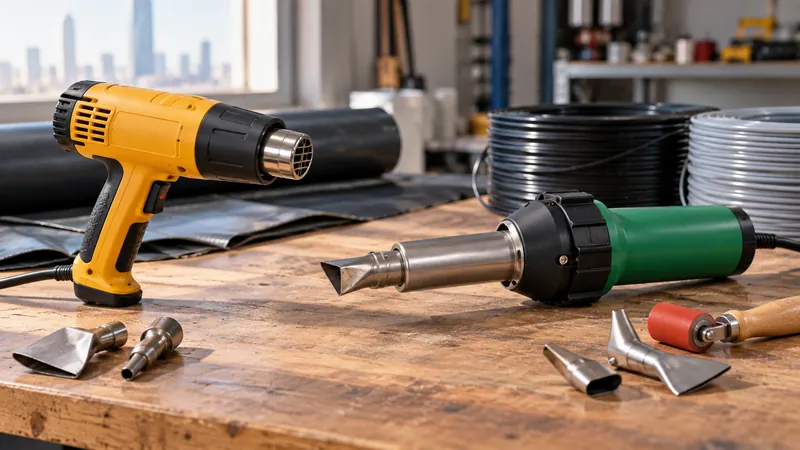
- A heat gun (consumer class) is a general-purpose heating tool — typically 2–3 fixed temperature settings, a wire-coil element, and a duty cycle designed for short DIY bursts: stripping paint, thawing pipes, bending small plastics.
- A hot air gun (professional class) is a precision instrument — stepless temperature control across a wide range (e.g. 40–700°C), a ceramic heating element that holds its setting under load, standardized nozzle seats for welding accessories, and a motor built for continuous industrial use. It's the tool that plastic welding, membrane roofing and industrial fabrication are built on.
In other words: every hot air gun can do a heat gun's job, but a heat gun cannot do a hot air gun's job.
The 5 Real Differences
| Difference | Heat gun (consumer) | Hot air gun (professional) |
|---|---|---|
| Temperature control | Fixed steps; actual output drifts | Stepless and stable — critical because each plastic has a narrow welding window |
| Heating element | Wire coil, limited lifespan | Ceramic, even heat, replaceable, lasts years |
| Duty cycle | Minutes at a time before overheating | Continuous shifts; dust-filtered motor for site conditions |
| Accessory system | A few clip-on deflectors | Standard nozzle seat: speed-welding nozzles, slot nozzles, reflectors, rollers |
| Serviceability | Disposable when it fails | Elements and carbon brushes replaced in minutes |
When a Basic Heat Gun Is Enough
Be fair to the humble heat gun — for occasional home tasks it's the right buy: stripping old paint, loosening rusted bolts or stickers, shrinking the odd cable sleeve, waxing a surfboard. If the tool comes out a few times a year for jobs where 30°C of temperature drift changes nothing, spending more buys you nothing.
When You Need a Professional Hot Air Gun
- Plastic welding of any kind — PVC/TPO membranes, tarpaulins, HDPE repairs, fabrications. Welding lives in narrow temperature windows; drift means scorched or cold seams. This is the territory of tools like the Weldy HT1600.
- Documented, repeatable work — consultant-supervised waterproofing and production welding, where a digital tool like the Weldy HT1600 D regulates against a probe and stores approved presets.
- Daily commercial use — any tool that works shifts needs the continuous-duty motor, dust filtering and replaceable parts of the professional class.
- High-volume shrinking, forming and drying — where the 3400W class such as the Weldy HT3400 covers large areas at speed.
If you're now weighing specific models, our best hot air gun in UAE buyer's guide compares them by use case, and the UAE welding machine price guide covers what each class costs.
And No — a Hair Dryer Is Not a Substitute
It comes up more than you'd think. A hair dryer tops out around 60–70°C by design (it points at human skin); even soft plastics need roughly double that to form, and welding temperatures run 250–450°C+. A hair dryer can help stretch a phone screen protector or remove a sticker — beyond that, it's the wrong tool, and forcing it is how motors burn out.
The Bottom Line
Call it a heat gun or a hot air gun — what matters is the class of tool behind the name. Occasional DIY: a consumer heat gun is honest value. Anything involving welding, membranes or daily commercial use: a professional hot air gun is not an upgrade, it's the entry requirement. Browse the professional class in our machines and tools range or call +971 50 178 9490 and describe the job — we'll tell you honestly whether you need to spend the money.
FAQs — Hot Air Gun vs Heat Gun
Is a hot air gun the same as a heat gun?
The names are used interchangeably, but professionally they describe different classes: heat guns are fixed-setting DIY tools, while hot air guns offer stepless, stable temperature control, ceramic elements, welding nozzle systems and continuous-duty motors for industrial work.
Can I use a hair dryer instead of a hot air gun?
No. Hair dryers reach only about 60–70°C — enough to lift a sticker, nowhere near the 250–450°C+ that plastic forming and welding require. Using one for heat-tool jobs mainly risks burning out the dryer.
Can a normal heat gun weld plastic?
Not reliably. Welding needs stable temperature within a narrow window plus proper welding nozzles — consumer heat guns have neither. Results are scorched, weak or inconsistent seams.
How many watts should a hot air gun have?
1600W is the professional standard for welding and general work; 3400W-class tools exist for large-area shrinking, forming and drying where coverage speed matters more than fine control.
What temperature does a hot air gun reach?
Professional tools adjust steplessly from about 40°C up to 620–700°C depending on model — covering everything from gentle film shrinking to high-temperature welding of engineering plastics.
Which hot air gun should I buy in the UAE?
For most professional users, the 1600W class (Weldy HT1600) is the best starting point; digital and 3400W variants cover certified welding and high-volume heating respectively. Call +971 50 178 9490 for a recommendation matched to your work.









 Pool Tiles


