



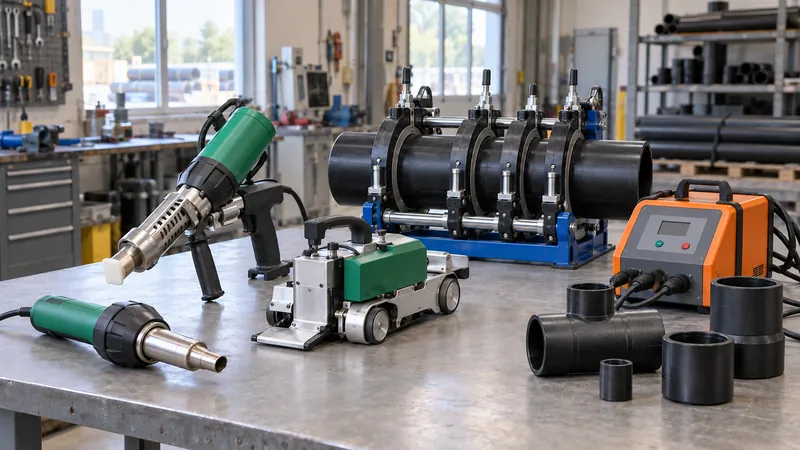
Ask "what are the types of welding machines?" and most answers dive into MIG, TIG and arc — metal welding. But if your work is thermoplastics — membranes, liners, tanks, pipes, films — that list is useless to you. Plastic welding has its own family of machines, each built around a different way of getting two pieces of plastic hot enough to fuse.
Here are the five types of plastic welding machines used across UAE construction, fabrication and geosynthetics work, what each one does best, and how to pick between them.
Table of Contents
Toggle1. Hot Air Welding Machines (Hot Gas Welders)
How they work: a blower pushes air over a ceramic heating element and out through a nozzle; the operator directs the heated air stream to soften the joint surfaces (and optionally a thin filler rod), pressing them together by hand or roller.
Best for: membrane and sheet welding, repairs, detail work, tacking, shrinking and drying. The hand-held format reaches corners, upstands and penetrations no machine can.
Machines: the 1600W Weldy HT1600 is the professional standard, the HT1600 D adds digital probe control for documented welds, the 3400W HT3400 covers large-area heating, and dedicated hot gas welding machines serve thermoplastic fabrication lines.
2. Extrusion Welding Machines (Hand Extruders)
How they work: thermoplastic wire feeds into a heated barrel where a screw plasticises it; the machine extrudes the molten material as a thick bead into a prepared joint while hot air preheats the parent surfaces. The bead and surfaces fuse into one structural mass. (Full process in our extrusion welding guide.)
Best for: thick-wall structural joints — HDPE/PP tanks, containers, large pipes, and the corners, penetrations and repairs on lined containment works.
Machines: the Weldy Booster EX2 (2.5 kg/h) for versatile fabrication and the Booster EX3 (3.4 kg/h) for production seams, alongside general extrusion welding machines for workshop duty.
3. Hot Wedge Welding Machines (Wedge Welders)
How they work: a self-propelled machine drives two overlapping sheets over an electrically heated metal wedge; pressure rollers fuse the molten surfaces immediately behind it. Geomembrane models weld a double seam with an air-testable channel between the tracks. (Details in our wedge welder guide.)
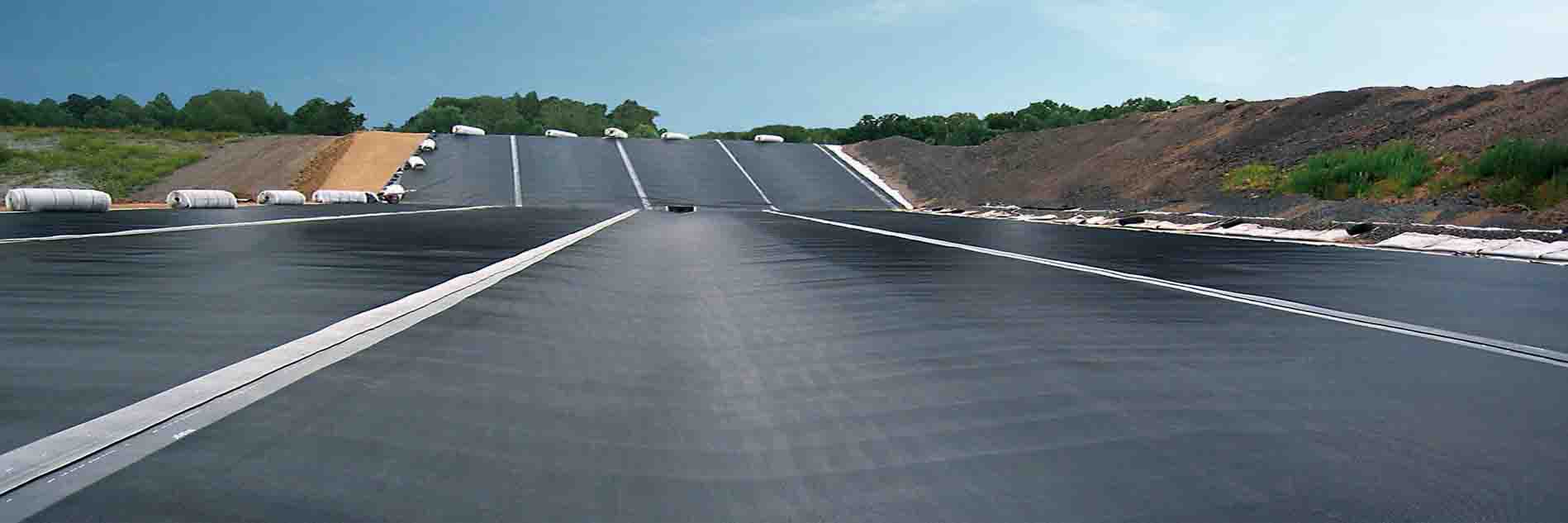
Best for: long, uniform seams on films, membranes and geomembranes — ponds, landfills, reservoirs, roofing and industrial fabrics — at speeds hand welding can't touch.
Machines by thickness: Miniwelder Tex1 (0.05–1.0mm foils), Tex2 (0.1–1.0mm membranes), Geo2 (0.5–1.5mm liners with test channel), and the heavy-duty WGW 300 for HDPE up to 2.5mm.
4. Butt Fusion Machines (Pipe Welding)
How they work: the machine clamps two pipe ends, faces them flat, heats both against a heated plate, then presses them together under controlled force until fused — creating a joint as strong as the pipe itself.
Best for: HDPE pressure pipelines — water networks, irrigation mains, sewage and industrial piping — where the pipe diameter and wall thickness rule out hand methods. This is the core of thermoplastic pipe welding technology on UAE infrastructure projects.
5. Electrofusion Machines (Pipe Fittings)
How they work: special fittings with embedded heating coils slide over the pipe ends; the machine passes a controlled current through the coils, melting the fitting and pipe surfaces together from the inside. No open heat, minimal operator skill dependency.
Best for: joints in confined trenches, repairs on live networks, and gas/water fittings where butt fusion machines can't fit — the standard partner technology to butt fusion on pipe projects.
The 5 Types Side by Side
| Type | Operation | Typical work |
|---|---|---|
| Hot air welder | Manual, hand-guided | Membranes, repairs, details, shrinking |
| Extrusion welder | Manual, filler bead | Structural tanks, containers, liner details |
| Hot wedge welder | Automatic, self-propelled | Long seams on films, membranes, geomembranes |
| Butt fusion machine | Clamped, plate-heated | HDPE pipe-to-pipe joints |
| Electrofusion machine | Current through coil fittings | Pipe fittings, tight-space and repair joints |
How to Choose: Three Questions
- What's the geometry? Sheets and membranes → hot air or wedge. Thick structural joints → extrusion. Pipes → butt fusion or electrofusion.
- How long are the seams? Metres of detail → manual tools. Hundreds of metres of straight seam → automatic wedge machine.
- Does QC require testing? Testable double seams come from geomembrane wedge welders; structural coupon tests pair with extrusion welding.
Most real projects combine types — a wedge machine on the long liner seams, an extruder on the details, a hot air gun for tacks and patches. Browse all classes in our plastic welding machines and tools range, check costs in the UAE price guide, or call +971 50 178 9490 with your job spec — we'll name the machine (or combination) in one call.
FAQs — Types of Plastic Welding Machines
What are the five types of plastic welding machines?
Hot air welders, extrusion welders, hot wedge welding machines, butt fusion machines and electrofusion machines — covering sheets and membranes, structural fabrication, long automatic seams, and pipe joining respectively.
What are the three main types used on membrane and liner projects?
Hot air guns (details, tacks, repairs), wedge welders (long seams) and extrusion welders (structural details and penetrations) — most lining crews carry all three.
Which machine welds HDPE pond and landfill liners?
Hot wedge machines: the Miniwelder Geo2 class up to 1.0–1.5mm, and heavy-duty units like the WGW 300 for HDPE up to 2.5mm — with an extrusion welder alongside for details.
Which machine joins HDPE pipes?
Butt fusion machines for pipe-to-pipe joints, and electrofusion machines for fittings, tight spaces and repairs.
Are MIG, TIG and arc welders types of plastic welding machines?
No — those are metal welding processes. Plastic welding uses heat and pressure without electrodes or shielding gas, through the five machine types above.
Can one machine do everything?
No single machine covers all five roles — the physics of each joint type differs. The practical minimum for membrane work is a hot air gun; serious lining or fabrication adds a wedge welder or extruder as the workload dictates.









 Pool Tiles


